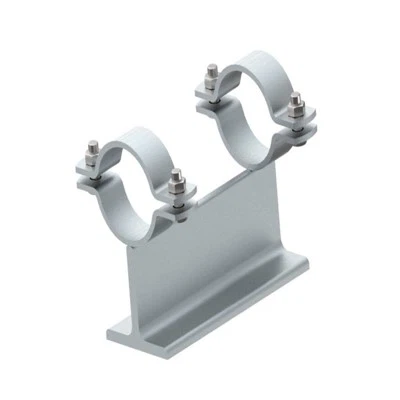
Can a failed constant spring bracket be repaired? That's a question I get asked a lot as a supplier of Constant Spring Brackets. In this blog, I'm gonna dive deep into this topic, sharing my insights based on years of experience in the industry.
First off, let's understand what a Constant Spring Bracket is. A Constant Spring Bracket, as the name suggests, is a crucial component used to support pipes and equipment in various industries. It's designed to provide a constant supporting force over a specific range of movement, which helps in maintaining the stability and integrity of the piping system. You can learn more about it on this page: Constant Spring Bracket.
Now, when it comes to a failed constant spring bracket, there are several reasons why it might fail. One common cause is overloading. If the bracket is subjected to a load that exceeds its designed capacity, it can lead to deformation or even breakage of the springs. Another reason could be corrosion. In environments where there's a lot of moisture or chemicals, the metal parts of the bracket can corrode over time, weakening the structure. Wear and tear from continuous use can also contribute to the failure of the bracket.
So, can it be repaired? Well, the answer is it depends. In some cases, minor issues can be fixed. For example, if the problem is just a loose bolt or a small crack in the housing, these can often be repaired relatively easily. A technician can tighten the bolts or weld the crack to restore the functionality of the bracket. However, when it comes to the springs themselves, things get a bit more complicated.
If the springs are deformed or broken, repairing them might not be a viable option. Springs are designed to have very specific properties, such as a certain stiffness and pre - load. Once they're damaged, it's difficult to restore these properties accurately. In most cases, replacing the springs is the better solution. And if the corrosion has severely weakened the structure of the bracket, it might be more cost - effective and safer to replace the entire bracket rather than trying to repair it.


Let's talk about the process of assessing whether a repair is possible. The first step is a thorough inspection. A trained technician will examine the bracket carefully, looking for signs of damage, wear, and corrosion. They'll check the springs for any visible deformation or breakage, and also inspect the housing and other components for cracks or loose parts. Specialized tools like calipers and load testers might be used to measure the dimensions and the force characteristics of the springs.
Based on the inspection results, a decision can be made. If the damage is minor and the bracket can be repaired, the technician will then proceed with the repair work. This might involve cleaning the corroded parts, tightening bolts, or performing minor welding. After the repair, the bracket should be tested to ensure that it's functioning properly. It should be able to provide the required constant force within the specified range of movement.
On the other hand, if the damage is extensive and the repair is not practical, the best course of action is to replace the bracket. As a supplier, I always recommend using high - quality replacement parts to ensure the long - term performance and reliability of the piping system. You can find more information about the function and use of constant spring brackets on this page: Function and Use.
In the oil and gas industry, constant spring brackets play a particularly important role. The pipelines in this industry carry high - pressure fluids and are often exposed to harsh environments. A failed constant spring bracket in an oil and gas pipeline can have serious consequences, such as leaks or even pipeline failures. That's why it's crucial to have a proper maintenance and inspection program in place. For more details about constant force spring support for oil and gas pipelines, check out this page: Constant Force Spring Support For Oil And Gas Pipeline.
When it comes to making the decision between repair and replacement, cost is also an important factor. Repairing a bracket might seem like the cheaper option at first glance, but if it requires a lot of time and labor, and there's a risk of the problem recurring, it might end up being more expensive in the long run. Replacement, on the other hand, provides a fresh start with a new, reliable bracket.
In conclusion, while some minor issues with a failed constant spring bracket can be repaired, in many cases, replacement is the better solution. It's important to have a professional inspection done to accurately assess the situation and make the right decision. As a supplier of Constant Spring Brackets, I'm here to help you with all your needs, whether it's assessing the damage, providing replacement parts, or offering advice on maintenance. If you're facing issues with your constant spring brackets or are in the market for new ones, don't hesitate to reach out for a procurement discussion. We can work together to find the best solution for your specific requirements.
References
- Industry standards and guidelines for constant spring brackets
- Technical manuals provided by spring bracket manufacturers
- Case studies on the repair and replacement of constant spring brackets in various industries