


Hey there! As a supplier of Pipe Saddle Support, I often get asked about how to calculate the load on these supports. It's a crucial aspect, as getting the load calculation right ensures the safety and efficiency of the piping system. So, let's dive into it!
Understanding the Basics of Pipe Saddle Support
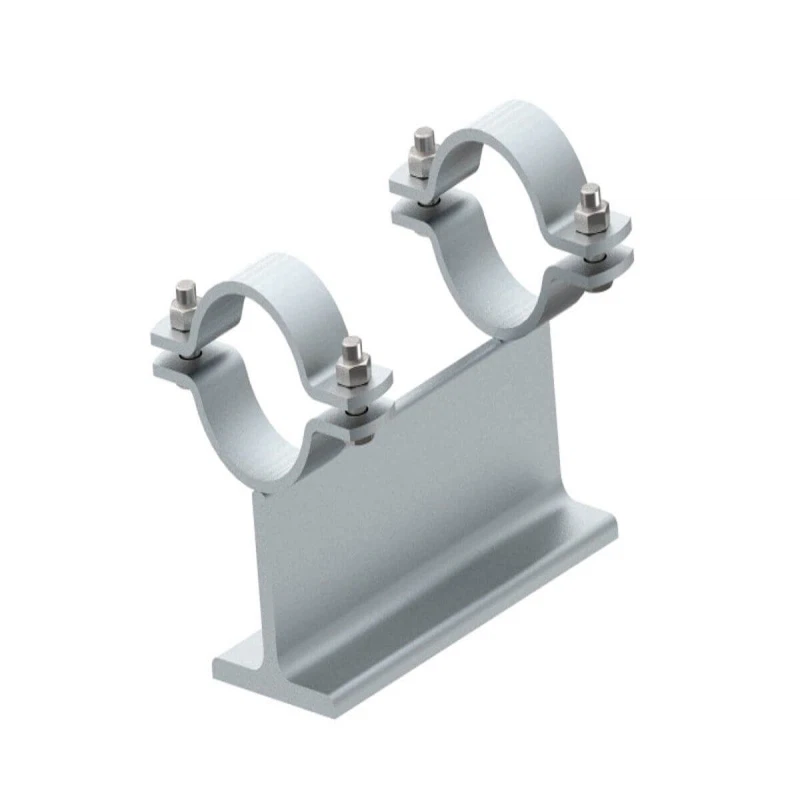
First off, a Pipe Saddle Support is a type of rigid support used to hold pipes in place. It's designed to distribute the weight of the pipe and its contents evenly, preventing excessive stress on the pipe and the support structure. These supports come in various shapes and sizes, depending on the application and the load requirements.
Factors Affecting the Load on a Pipe Saddle Support
There are several factors that can influence the load on a pipe saddle support. Let's take a look at each of them:
1. Weight of the Pipe
The weight of the pipe itself is a significant factor. This includes the weight of the pipe material, which can vary depending on the type of metal (e.g., steel, stainless steel, or aluminum) and the pipe's dimensions (diameter and wall thickness). You can calculate the weight of the pipe using standard formulas based on its cross - sectional area and the density of the material.
2. Weight of the Fluid Inside the Pipe
If the pipe is carrying a fluid, the weight of that fluid also adds to the load. The weight of the fluid depends on its density and the volume of the pipe. For example, water has a density of about 1000 kg/m³. If you know the length and diameter of the pipe, you can calculate the volume of the fluid it can hold and then determine its weight.
3. Insulation Weight
In many cases, pipes are insulated to prevent heat loss or gain. The weight of the insulation material, such as fiberglass or foam, needs to be considered. You can find the weight per unit area of the insulation material and multiply it by the surface area of the pipe covered by the insulation.
4. External Loads
External loads can come from various sources. For instance, wind can exert a force on the pipe, especially if it's installed outdoors. Seismic activity can also cause additional loads on the pipe and its supports. In areas prone to earthquakes, engineers need to factor in seismic loads when calculating the total load on the pipe saddle support.
5. Thermal Expansion and Contraction
Pipes can expand or contract due to temperature changes. When a pipe expands, it can put extra stress on the supports. This thermal load depends on the coefficient of thermal expansion of the pipe material, the temperature change, and the length of the pipe.
Calculating the Load on a Pipe Saddle Support
Step 1: Determine the Static Load
The static load is the sum of the weight of the pipe, the fluid inside the pipe, and the insulation (if any).
Let's say we have a steel pipe with a length (L), outer diameter (D), and wall thickness (t). The density of steel is (\rho_{s}). The volume of the pipe material (V_{p}) can be calculated as:
[V_{p}=\pi\left[\left(\frac{D}{2}\right)^{2}-\left(\frac{D - 2t}{2}\right)^{2}\right]L]
The weight of the pipe (W_{p}=V_{p}\times\rho_{s}\times g), where (g) is the acceleration due to gravity ((g = 9.81m/s^{2})).
If the pipe is filled with a fluid of density (\rho_{f}), the volume of the fluid (V_{f}=\pi\left(\frac{D - 2t}{2}\right)^{2}L), and the weight of the fluid (W_{f}=V_{f}\times\rho_{f}\times g).
If there's insulation with a weight per unit area (w_{i}) and the surface area of the pipe covered by insulation (A_{i}=\pi DL), the weight of the insulation (W_{i}=w_{i}\times A_{i}).

The static load (W_{static}=W_{p}+W_{f}+W_{i})
Step 2: Calculate the External Loads
As mentioned earlier, wind and seismic loads need to be considered. For wind load, you can use wind load calculation standards based on the local wind speed and the shape and size of the pipe. Seismic loads are calculated using seismic design codes, which take into account the seismic zone, the type of soil, and the characteristics of the piping system.
Let the wind load be (W_{wind}) and the seismic load be (W_{seismic}).
Step 3: Account for Thermal Loads
The thermal load (W_{thermal}) can be calculated using the formula (W_{thermal}=F_{thermal}), where (F_{thermal}=k\times\Delta T\times L). Here, (k) is the spring constant of the support (which depends on the support design), (\Delta T) is the temperature change, and (L) is the length of the pipe.
Step 4: Calculate the Total Load
The total load (W_{total}=W_{static}+W_{wind}+W_{seismic}+W_{thermal})
Importance of Accurate Load Calculation
Getting the load calculation right is super important. If the load on the pipe saddle support is underestimated, the support may fail, leading to pipe sagging, leaks, or even a complete collapse of the piping system. On the other hand, overestimating the load can result in using oversized and more expensive supports, which is a waste of resources.
Our Pipe Saddle Support Solutions
At our company, we offer a wide range of Pipe Saddle Support products. We also have T - Type Pipe Support with Wear Pad and T - Type Pipe Supports with Clamp for different applications. Our supports are designed to handle various loads, and we can work with you to ensure you get the right support for your specific needs.
If you're in the process of designing a piping system or need to replace existing supports, we're here to help. Our team of experts can assist you with load calculations and recommend the most suitable support solutions. Whether it's a small - scale project or a large industrial installation, we've got you covered.
So, if you're interested in our Pipe Saddle Support products or need more information about load calculations, don't hesitate to reach out. We're always happy to have a chat and discuss your requirements. Contact us today to start the conversation about your piping support needs!
References
- "Piping Handbook" by Mohinder L. Nayyar
- ASME B31.3 Process Piping Code
- Seismic Design Codes for Piping Systems


