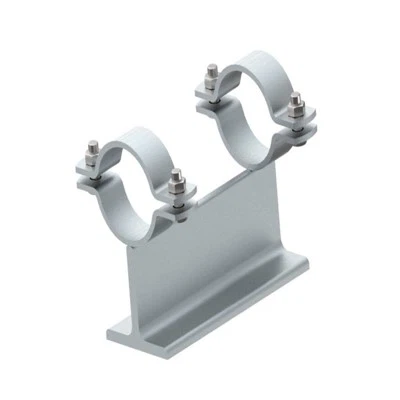
Hey there! As a supplier of rigid pipe supports, I've seen firsthand how crucial it is to choose the right base plate for your needs. A proper base plate can ensure the stability and longevity of your pipe support system, while a wrong choice can lead to all sorts of problems down the road. So, let's dive into how you can pick the perfect base plate for your rigid pipe support.
Understanding the Basics of Base Plates for Rigid Pipe Supports
First off, what exactly is a base plate in the context of a rigid pipe support? Well, it's the part that provides the foundation. It attaches the pipe support to the structure, like a building floor, a beam, or a concrete slab. Its main job is to distribute the weight of the pipe and its contents evenly across the supporting surface, preventing any concentrated loads that could damage the structure.
There are different types of base plates, and each has its own unique features and uses. Some are flat, while others might have a more complex shape to fit specific installation requirements. The material of the base plate also matters a lot. Common materials include steel, stainless steel, and sometimes even aluminum, depending on the environment and the load it needs to bear.
Factors to Consider When Choosing a Base Plate
Load Capacity
One of the most important things to think about is the load capacity. You need to know how much weight the base plate will be dealing with. This includes the weight of the pipe itself, the fluid or gas it's carrying, and any additional loads like wind or seismic forces. If the base plate can't handle the load, it could bend, crack, or even fail completely, which is a huge safety risk.
To figure out the load capacity, you'll need to do some calculations. Look at the specifications of your pipe system, including its diameter, wall thickness, and the density of the fluid or gas inside. You might also need to consult an engineer if the situation is complex. Make sure to choose a base plate with a load capacity that exceeds the actual load to provide a safety margin.
Environmental Conditions
The environment where the pipe support will be installed plays a big role in base plate selection. If it's an outdoor installation, you'll need to worry about things like corrosion. For example, in a coastal area where there's a lot of salt in the air, stainless steel or a coated steel base plate would be a good choice because they're more resistant to rust.
On the other hand, if the installation is in a high - temperature environment, like near a furnace or in a power plant, the base plate material needs to be able to withstand the heat without losing its strength. Some special alloys are designed for such high - temperature applications.
Pipe Size and Type
The size and type of the pipe are also key factors. Larger pipes generally require larger and stronger base plates to support them properly. Different types of pipes, such as those used for water, oil, or chemicals, might have different support requirements. For instance, a pipe carrying a highly corrosive chemical might need a base plate with a special coating to prevent chemical attack.
Installation Requirements
How the base plate will be installed is another consideration. Some base plates are bolted to the structure, while others might be welded. The installation method can affect the choice of base plate. For example, if welding is the chosen method, the base plate material needs to be weldable. Also, consider the available space for installation. If space is limited, you might need a more compact base plate design.


Different Types of Base Plates and Their Applications
Flat Base Plates
Flat base plates are the most common type. They're simple and easy to install, making them a popular choice for many applications. They're great for situations where the load is evenly distributed and the installation surface is flat. For example, in a standard industrial building where pipes are supported on a flat concrete floor, a flat base plate would work well. You can check out Pipe Saddle Support which often uses flat base plates for stable support.
Tapered Base Plates
Tapered base plates are designed to distribute the load more evenly in certain situations. They're thicker at the center and thinner at the edges. This design can be useful when the load is concentrated in the middle of the base plate or when the supporting surface has some irregularities. They're often used in applications where there's a risk of uneven settlement.
Custom - Designed Base Plates
Sometimes, standard base plates just won't cut it. That's when custom - designed base plates come in handy. If you have a unique pipe system with specific load, environmental, or installation requirements, a custom base plate can be made to fit your exact needs. This might cost a bit more, but it can save you a lot of headaches in the long run. For example, if you have a complex pipe layout in a tight space, a custom - designed T - Type Pipe Support with Wear Pad with a specially shaped base plate could be the solution.
Matching Base Plates with Rigid Pipe Support Types
Pipe Saddle Supports
Pipe saddle supports are used to cradle the pipe and provide support along its length. When choosing a base plate for a pipe saddle support, you need to make sure it can distribute the load from the saddle evenly. A flat or slightly curved base plate is often used to match the shape of the saddle and the supporting surface. The size of the base plate should be large enough to prevent excessive stress on the supporting structure.
T - Type Pipe Supports
T - type pipe supports come in different variations, such as T - Type Pipe Supports with Clamp. These supports are designed to hold the pipe in place from the side. The base plate for a T - type support needs to be able to handle the lateral forces as well as the vertical load. A well - designed base plate will ensure that the support remains stable and doesn't tip over under the influence of the pipe's movement or external forces.
Making the Final Decision
Once you've considered all the factors and narrowed down your options, it's time to make the final decision. It's a good idea to get samples of the base plates you're considering if possible. Inspect them for quality, such as the smoothness of the surface, the accuracy of the dimensions, and the quality of the finish.
If you're still not sure, don't hesitate to consult with experts. As a rigid pipe support supplier, I'm always here to help. I can provide you with more detailed information about different base plate options and how they'll work with your specific pipe support system.
Conclusion
Choosing the right base plate for a rigid pipe support is not a decision to be taken lightly. It requires careful consideration of load capacity, environmental conditions, pipe size and type, and installation requirements. By understanding the different types of base plates and how they match with various pipe support types, you can make an informed choice that will ensure the safety and efficiency of your pipe system.
If you're in the market for rigid pipe supports and need help with base plate selection or have any other questions, feel free to reach out. We're here to assist you in finding the best solutions for your pipe support needs.
References
- ASME B31.1 Power Piping Code
- ASTM Standards for Steel and Stainless Steel Materials
- Engineering textbooks on structural design and pipe support systems