Hey there! As a supplier of Constant Spring Supports, I often get asked about how to calculate the load for these nifty devices. So, I thought I'd put together this blog post to break it down for you in a way that's easy to understand.
First off, let's talk about why calculating the load for a constant spring support is so important. These supports are used in a variety of industries, from power plants to chemical processing facilities, to help support pipes and equipment that are subject to thermal expansion and contraction. If the load isn't calculated correctly, the spring support won't work properly, which can lead to all sorts of problems, like pipe stress, equipment damage, and even safety hazards.
So, how do you calculate the load for a constant spring support? Well, it's not as complicated as it might seem, but it does require a little bit of math and some basic knowledge of the system you're working with.
Step 1: Determine the Operating Load
The first step in calculating the load for a constant spring support is to determine the operating load. This is the load that the support will be subjected to during normal operation. To calculate the operating load, you'll need to know the weight of the pipe or equipment that the support will be holding, as well as any additional loads, like fluid weight, insulation weight, and seismic loads.
Let's say you're working on a pipeline that has a weight of 1000 pounds. You also know that the fluid in the pipeline weighs 500 pounds, and the insulation weighs 200 pounds. To calculate the operating load, you simply add these weights together:
Operating Load = Pipe Weight + Fluid Weight + Insulation Weight
Operating Load = 1000 + 500 + 200
Operating Load = 1700 pounds
Step 2: Determine the Thermal Movement
The next step is to determine the thermal movement. This is the amount of movement that the pipe or equipment will experience due to thermal expansion or contraction. To calculate the thermal movement, you'll need to know the coefficient of thermal expansion for the material that the pipe or equipment is made of, as well as the temperature change that the system will experience.
Let's say you're working with a steel pipeline that has a coefficient of thermal expansion of 0.0000065 inches per inch per degree Fahrenheit. The pipeline is expected to experience a temperature change of 200 degrees Fahrenheit. To calculate the thermal movement, you use the following formula:
Thermal Movement = Coefficient of Thermal Expansion x Length of Pipe x Temperature Change
Let's assume the length of the pipe is 100 feet, which is 1200 inches.

Thermal Movement = 0.0000065 x 1200 x 200
Thermal Movement = 1.56 inches
Step 3: Select the Appropriate Spring Support
Once you've determined the operating load and the thermal movement, you can select the appropriate spring support. There are several factors to consider when selecting a spring support, including the load capacity, the travel range, and the type of spring.
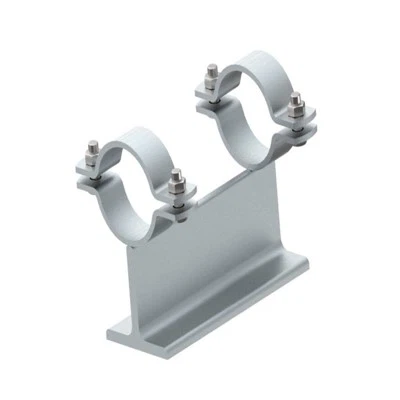
At our company, we offer a wide range of Constant Force Disc Spring Support Hanger, Single-ear High-precision Spring Hanger, and Constant Spring Bracket to meet your specific needs. Our spring supports are designed to provide constant support over a wide range of loads and movements, ensuring reliable performance in even the most demanding applications.
Step 4: Calculate the Spring Rate
The spring rate is the amount of force required to compress or extend the spring by one inch. To calculate the spring rate, you use the following formula:
Spring Rate = Operating Load / Travel Range
Let's say you've selected a spring support with a travel range of 2 inches. Using the operating load of 1700 pounds from our previous example, the spring rate would be:
Spring Rate = 1700 / 2
Spring Rate = 850 pounds per inch
Step 5: Check the Spring Capacity
Once you've calculated the spring rate, you need to check the spring capacity to make sure it can handle the load. The spring capacity is the maximum load that the spring can support without exceeding its design limits.
At our company, we provide detailed specifications for all of our spring supports, including the load capacity and the spring rate. Make sure to choose a spring support with a load capacity that is greater than the operating load to ensure safe and reliable operation.
Step 6: Consider Additional Factors
In addition to the operating load and the thermal movement, there are several other factors that you need to consider when calculating the load for a constant spring support. These include:
- Dynamic Loads: If the system is subject to dynamic loads, like vibration or shock, you'll need to factor these into your calculations.
- Installation Conditions: The installation conditions, such as the orientation of the support and the type of mounting, can also affect the performance of the spring support.
- Code Requirements: Make sure to comply with all relevant codes and standards when selecting and installing the spring support.
Conclusion
Calculating the load for a constant spring support is an important step in ensuring the safe and reliable operation of your piping system. By following the steps outlined in this blog post, you can accurately calculate the load and select the appropriate spring support for your application.
If you have any questions or need help selecting the right spring support for your project, don't hesitate to contact us. Our team of experts is always here to assist you. We're committed to providing high-quality spring supports and excellent customer service, so you can trust us to meet your needs.
References
- Marks' Standard Handbook for Mechanical Engineers
- ASME B31.1 Power Piping Code
- ASME B31.3 Process Piping Code